Palm Springs is best known internationally as the mid-century modern resort town where Hollywood luminaries came to escape the city - and where some of the most significant residential architecture of the 20th century was built against a backdrop of San Jacinto Mountain and desert sky. But Palm Springs is also, and less obviously, a serious art town: home to one of the most significant art museums in California, a gallery district that has grown steadily over two decades, and a cultural identity that weaves together modernist design, Indigenous art, and a contemporary scene that reflects the diversity of the broader Los Angeles creative community.
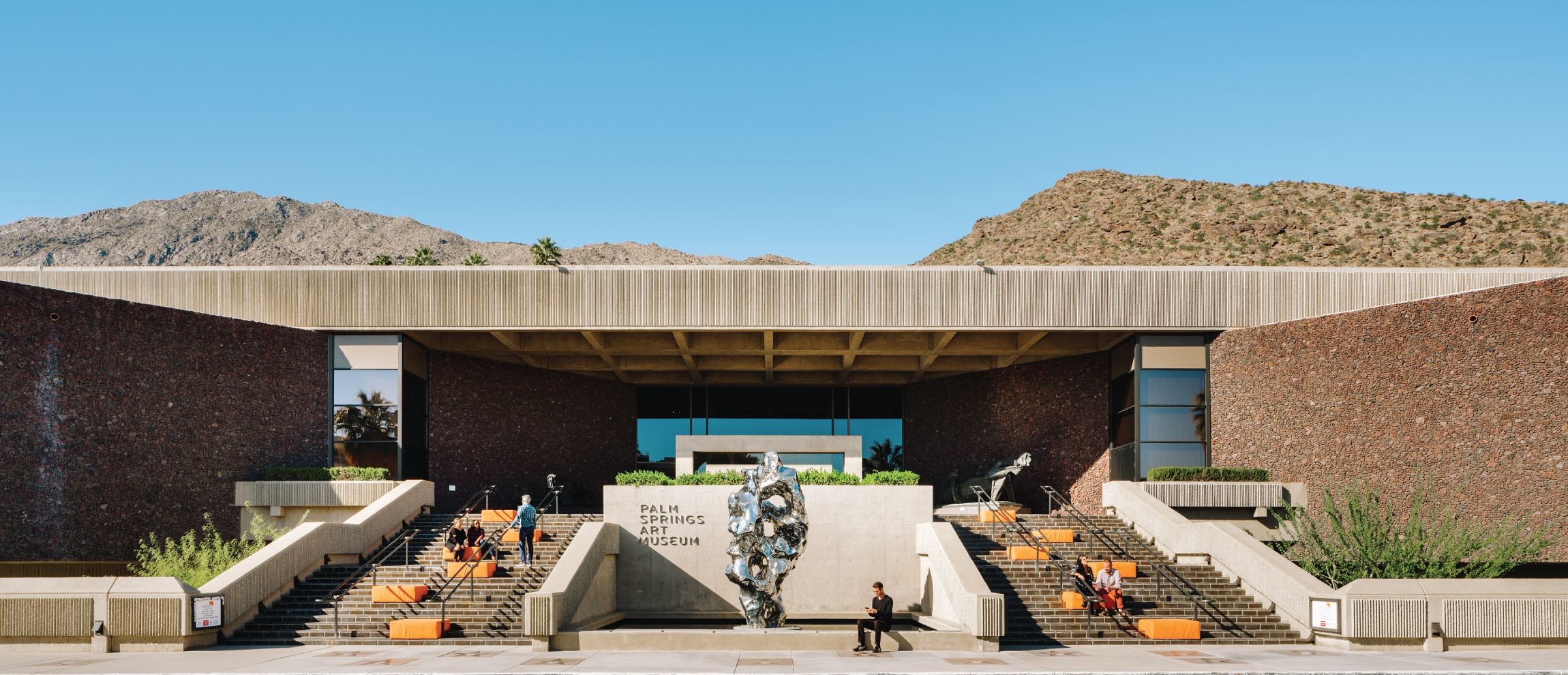
The Palm Springs Art Museum is the cornerstone of the valley's arts ecosystem. Occupying a building designed in 1974 by E. Stewart Williams - one of the defining architects of desert modernism - the museum has undergone significant expansions and houses a permanent collection that spans pre-Columbian ceramics, 20th-century American art, contemporary photography, and a glass collection of international significance. The museum's architecture department maintains the Palm Springs Art Museum Architecture and Design Center, dedicated specifically to the built environment of the desert region, making it one of the only museums in the United States with a standalone institution devoted to architecture as a collecting discipline.
The Agua Caliente Cultural Museum, recently completed in downtown Palm Springs, represents the most significant investment in Indigenous cultural preservation in the Coachella Valley's history. The museum focuses on the culture, history, and art of the Agua Caliente Cahuilla people - who are the original stewards of this land - and presents their traditional arts, contemporary works, and living culture in a state-of-the-art facility that has itself become an architectural landmark.
The gallery district in downtown Palm Springs is concentrated primarily along North Palm Canyon Drive and the surrounding blocks. Galleries range from established dealers in 20th-century California art to younger spaces showing emerging artists from Los Angeles and the Coachella Valley itself. The Thursday VillageFest, a weekly street fair along Palm Canyon Drive, functions partly as an outdoor gallery with artists selling work alongside vendors and food stalls, and is one of the most accessible entry points to the local creative community for first-time visitors.
The Coachella Valley's art scene extends beyond Palm Springs. Cathedral City, Palm Desert, and Rancho Mirage all have galleries and cultural institutions, with the McCallum Theatre in Palm Desert functioning as the region's primary performing arts venue. The City of Palm Desert's Art in Public Places program has seeded outdoor sculpture throughout the city, making an art encounter possible in almost any public space.
El Paseo, Palm Desert's upscale shopping boulevard, hosts a significant concentration of galleries alongside its retail storefronts. The boulevard's Sculpture Garden, which changes annually, brings large-scale outdoor works to what is otherwise a conventional retail corridor and has attracted increasing attention from collectors and curators looking beyond Palm Springs proper. Some of the most significant purchases made in the Coachella Valley in recent years have begun with a chance encounter along El Paseo.
The Sunnylands Center and Gardens in Rancho Mirage - the former estate of Walter and Leonore Annenberg, which hosted presidents and world leaders for decades - has opened its grounds and arts programming to the public and provides a window into the collecting habits of one of the 20th century's most significant cultural philanthropists. The estate's art collection, which includes significant Impressionist and Post-Impressionist works, is displayed in a domestic setting that illuminates how art functions in the context of a fully realized private life.
The connection between desert modernism and the visual arts is central to Palm Springs' cultural identity. The architects who defined the city's built environment - Albert Frey, Richard Neutra, William Cody, Donald Wexler, John Lautner - were working in close dialogue with the visual arts of their era, and the glass walls, integrated indoor-outdoor spaces, and formal vocabulary of their buildings were influenced by the painting and sculpture being produced simultaneously in New York and Los Angeles. Visiting Palm Springs as an art traveler means engaging with architecture as art, reading the modernist houses as aesthetic statements as much as functional buildings.
Modernism Week, held each February and drawing tens of thousands of visitors to the Coachella Valley, is the region's largest arts and culture event. The ten-day festival includes architectural tours, gallery exhibitions, lectures, and design fairs that collectively celebrate Palm Springs' mid-century heritage while connecting it to contemporary practice. For art travelers, the Modernism Week calendar is an extraordinary opportunity to access private homes, studio visits, and curatorial programming that isn't available at any other time of year.
The desert landscape itself continues to be a generative force for art-making in the Coachella Valley. Joshua Tree National Park, about 45 minutes north of Palm Springs, has attracted artists and musicians since the 1960s - the towns of Joshua Tree and Twentynine Palms have developed a genuine artist-in-residence culture built around the landscape's otherworldly quality. The Hi-Desert Cultural Center anchors a small but serious arts community that is increasingly connected to the Palm Springs scene while maintaining its own distinct identity rooted in the high desert.
Collecting in Palm Springs tends to reflect the city's design heritage. Mid-century furniture, ceramics, and graphic arts from the 1950s and 1960s remain the most consistently traded categories, and the Palm Springs market is one of the better places in the country to acquire significant modernist decorative arts at prices that remain below their New York and Los Angeles equivalents. For collectors interested in California landscape painting - which has its own distinguished history rooted in the region's extraordinary light - the Coachella Valley galleries offer depth and selection that rival more prominent California art markets.
For visitors planning an art-focused trip to the Coachella Valley, the combination of the Palm Springs Art Museum, the Agua Caliente Cultural Museum, and the gallery district along North Palm Canyon Drive can fill two full days without repetition. Add a morning at Sunnylands and an afternoon on El Paseo in Palm Desert, and the valley reveals itself as a genuinely substantial art destination - one that rewards the visitor who arrives with curiosity rather than simply a checklist.
The desert light of the Coachella Valley has its own quality distinct from the high-altitude light of northern New Mexico or the canyon country of Utah. Filtered through the San Jacinto Mountains that rise abruptly from the valley floor, the afternoon light in Palm Springs is soft and warm and extraordinarily flattering to color - which may explain, at least in part, why so many artists have chosen to live and work here, and why the galleries along Palm Canyon Drive tend to show work in which color is doing significant expressive work.