Jerome, Arizona occupies an almost literally vertical position on Cleopatra Hill in the Black Hills of central Arizona, 5,200 feet above sea level and set at a pitch so steep that the town seems to defy gravity. Houses are stacked above each other on terraced lots, streets switchback up the hillside, and the views from almost any point in town extend across the Verde Valley to the red rocks of Sedona in the east and the San Francisco Peaks rising above Flagstaff to the north. It is one of the most dramatic physical settings of any town in the American Southwest, and that drama is inseparable from what makes Jerome a compelling arts destination.
Jerome's history follows the familiar arc of Arizona mining towns: discovery, boom, company dominance, collapse, and creative resurrection. The United Verde Copper Company and its successor Phelps Dodge operated here from the 1880s until 1953, making Jerome at its peak one of the largest cities in Arizona. The mine produced over a billion pounds of copper before the deposits gave out, leaving behind an extraordinary architectural legacy: Victorian commercial buildings, company-built worker housing, a hospital built into the hillside, and the Douglas Mansion, now a state park, which commands a view of the Verde Valley that remains one of the most spectacular in all of Arizona.
After the mine closed, Jerome declined to fewer than 100 residents by the 1960s. The buildings were cheap and the setting was magnificent, and by the early 1970s artists and writers had begun arriving to claim the abandoned storefronts and Victorian houses. Jerome became one of the earliest of the Southwest's mining-town-to-arts-destination transformations, preceding Bisbee's revival by a decade and establishing a template that has since been replicated in towns across the region.
The arts scene that emerged in Jerome has its own distinct character. The town is small enough - perhaps 500 permanent residents - that the arts community is genuinely intimate, with artists knowing each other's work and lives in a way that is impossible in larger markets. Galleries and studios are concentrated primarily along Main Street and Hull Avenue, a short strip that feels, on a busy weekend day, like a concentrated river of creative energy running through the hillside.
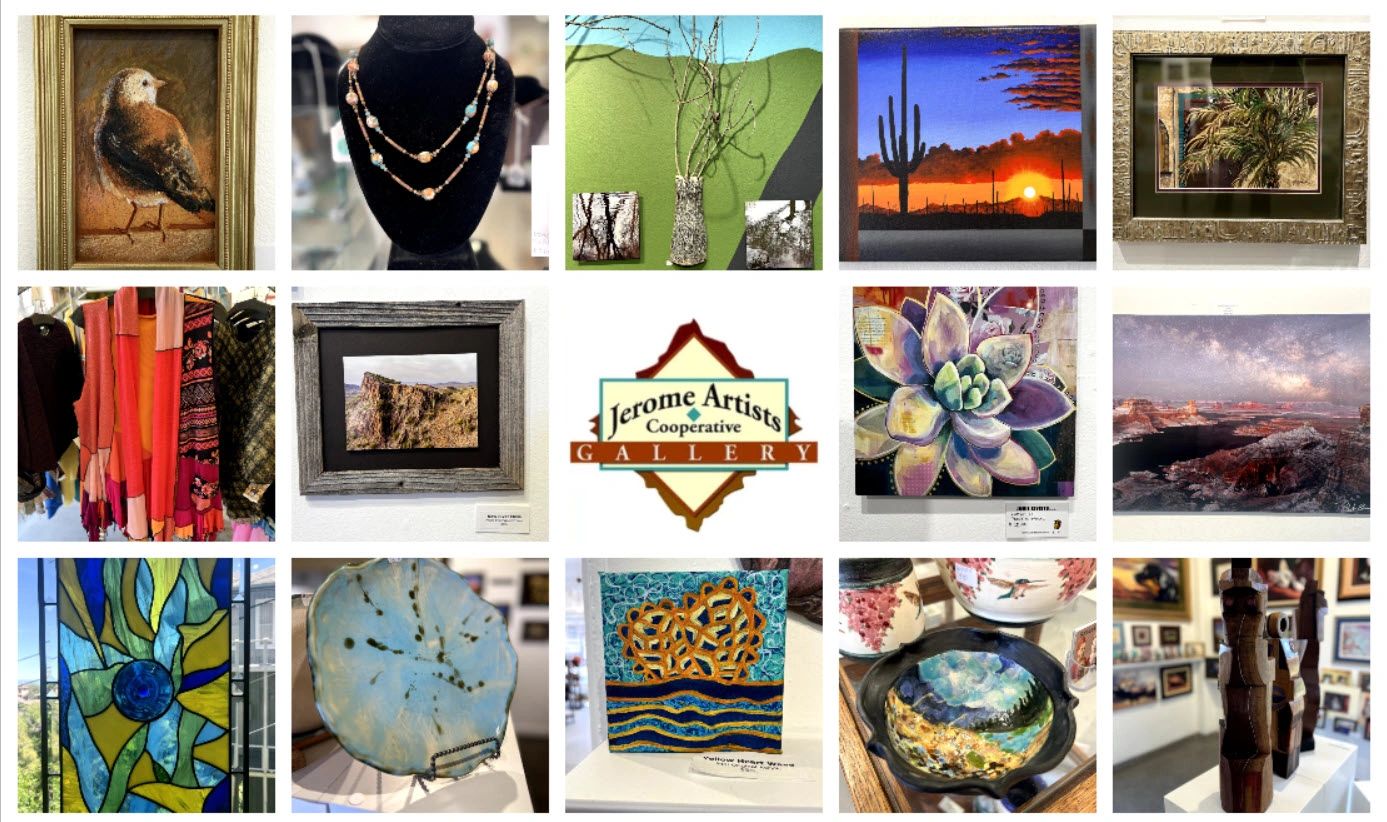
The Jerome Artists Cooperative Gallery is the community's central institution, a collective operated by and for Jerome's working artists that represents the full range of the town's creative output: painting, pottery, jewelry, glass, fiber arts, sculpture, and mixed media. The cooperative model means that visitors are typically able to meet the artists directly, with gallery shifts staffed by members themselves. For collectors who want direct engagement with the people behind the work, cooperative galleries like this one are invaluable - the conversation that begins at the desk often deepens into a lasting relationship between collector and artist.
The Raku Gallery is one of Jerome's most distinctive destinations, focused on raku-fired ceramics - a Japanese-derived technique in which pieces are removed from the kiln at peak temperature and subjected to rapid cooling that produces unpredictable but often extraordinary surface effects of smoke, metallic luster, and crackling glaze. The gallery represents several Jerome-based ceramic artists who have made raku their primary medium and developed personal approaches to the technique that reflect the Southwest's particular light, color, and thermal drama.
Jerome's setting in the Black Hills places it within easy reach of several significant natural and archaeological landmarks. Tuzigoot National Monument, in the Verde Valley below Jerome, preserves a large Sinagua pueblo inhabited from roughly 1000 to 1425 CE, and its museum houses significant ceramic and textile artifacts from the Southwest's pre-Columbian period. Montezuma Castle National Monument, about 20 miles south, contains one of the best-preserved cliff dwellings in North America. For artists and collectors interested in the deep history of Southwestern craft traditions, these sites provide essential context for understanding how the region's contemporary art connects to millennia of Indigenous creative practice.
The Jerome Art Walk, held on designated weekends throughout the year, draws visitors who move through the galleries and studios with focused intentionality. During Art Walk events, studios normally closed to the public open their doors, and artists who work primarily in private take on something of a pedagogical role, explaining their process and influences in the context of their own working spaces. These events are among the most revealing experiences available to a visitor interested in understanding how art actually gets made in a small working community.
The views from Jerome deserve sustained attention. The southwest-facing aspect of Cleopatra Hill means that Jerome receives the full force of afternoon light as it rakes across the Verde Valley and catches the faces of the red rock formations near Sedona. Painters working in Jerome have spent careers studying this light - the challenge and reward of painting from Jerome's hillside is a subject that comes up regularly in conversations with the town's landscape artists. Even visitors with no particular interest in painting tend to find themselves standing on Jerome's terraced streets at four in the afternoon, watching the light change, understanding for the first time why artists keep coming here.
Accommodation in Jerome is limited but characterful. The Connor Hotel, a historic property on Main Street, has been operating in some form since 1898 and provides an experience of the town that extends beyond the gallery visit into the texture of Jerome's daily life. Several bed-and-breakfast operations in the Victorian houses scattered up the hillside offer a more intimate alternative, with views from bedroom windows that have been known to inspire collecting decisions that the light of day only confirms.
The distance from Phoenix is manageable - about two hours on Interstate 17 and then the winding climb up State Route 89A from Cottonwood - and the Verde Valley offers enough additional attractions to make a two-day visit the natural format. Sedona is 30 miles south; Prescott, another historic Arizona community with its own growing arts scene, is 35 miles southwest. A Jerome visit pairs naturally with either, and the contrast between Jerome's vertical intensity and Sedona's horizontal grandeur is itself a kind of artistic education in the variety of forms the Southwest contains.